Nullam dignissim, ante scelerisque the is euismod fermentum odio sem semper the is erat, a feugiat leo urna eget eros. Duis Aenean a imperdiet risus.
Loading
Nullam dignissim, ante scelerisque the is euismod fermentum odio sem semper the is erat, a feugiat leo urna eget eros. Duis Aenean a imperdiet risus.
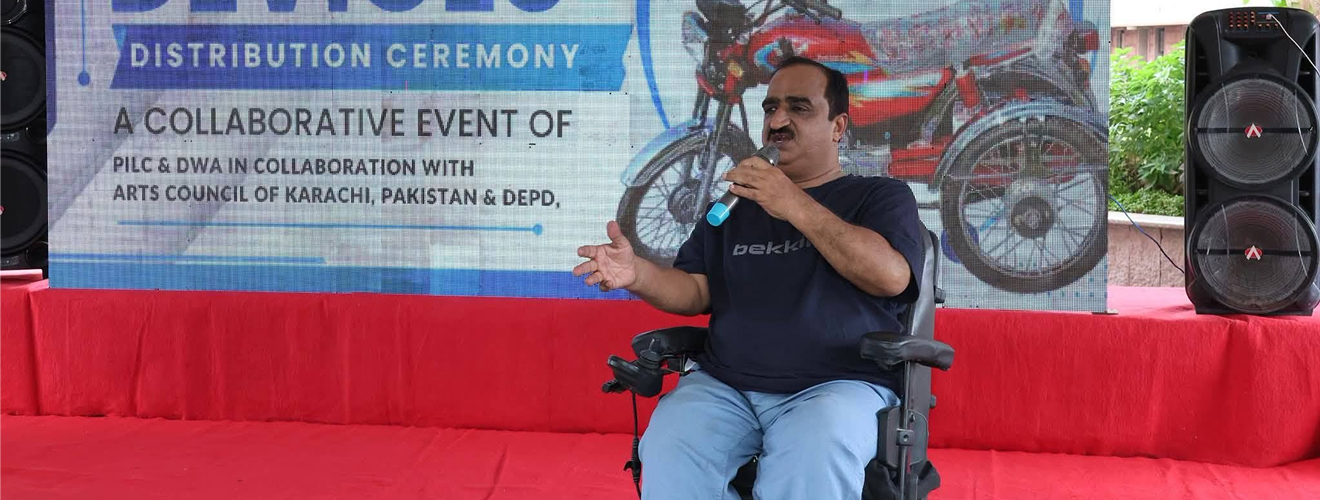
For millions of persons with disabilities in Sindh, independence can begin with a single device: a wheelchair, a hearing aid, or a white cane. Yet for many, that device remains out of reach.
The scale of the crisis is staggering. Sindh is home to more than six million children and adults with special needs, including people with physical, sensory, intellectual, and psychosocial disabilities. Across Pakistan, an estimated 25 to 40 million people live with some form of disability. Yet only about 1 to 2 percent of persons with disabilities in Pakistan have access to the latest assistive technologies. The remaining 98 percent must rely on conventional, and often inadequate, ways of managing their daily challenges.
The gap between urban and rural areas is wide. Access to locally made assistive equipment is somewhat better in major cities but remains severely limited in rural and remote areas. Most persons with disabilities cannot afford to import the latest technologies, while access to locally available products is largely concentrated in major urban centers.
The consequences are profound. Without appropriate assistive devices, persons with disabilities may be unable to attend school, work, move freely, communicate, or participate fully in community life. A child without a hearing aid may struggle to learn. An adult without a wheelchair may be unable to access employment. A person without a prosthetic limb may lose mobility and independence.
The legal framework exists, but implementation remains weak.
Existing disability legislation in Pakistan has historically given limited attention to assistive technology, while enforcement remains a major challenge. The Sindh Empowerment of Persons with Disabilities Act, 2018, provides a legal foundation for access to assistive devices, but the gap between policy and practice remains enormous.
Only about 120,000 people have reportedly benefited directly or indirectly from assistive device distribution programs, a fraction of the millions who need them.
To ensure that every person with a disability in Sindh has access to the assistive technologies they need to move, communicate, learn, work, and live with dignity and independence.
We believe that assistive technologies are not luxuries. They are essential to independence, participation, and equal opportunity.
Our mission is to bridge the gap between the millions who need assistive technologies and the small proportion who currently have access to them. We work to make assistive technologies available, affordable, accessible, and appropriate for every person who needs them, in every district of Sindh.
The first step is ensuring that assistive technology is prioritized in policy and practice.
The Sindh Empowerment of Persons with Disabilities Act, 2018, provides a legal foundation, but it must be fully implemented. We advocate for:
We work with government and partner organizations to ensure that assistive devices reach the people who need them most.
In fiscal year 2025–26, the Sindh Government allocated Rs. 800 million for assistive devices, with funds distributed among 105 partner organizations and NGOs. This has supported the provision of wheelchairs, hearing aids, prosthetic limbs, and other assistive devices.
We work to ensure that these devices reach persons with disabilities across all districts of Sindh. Recent distributions have reached persons with disabilities in Karachi, Hyderabad, Sukkur, Tharparkar, Shaheed Benazirabad, Mirpurkhas, Khairpur, Ghotki, Badin, and Larkana.
Importing assistive devices can be expensive and difficult. Local manufacturing can make assistive technologies more affordable, appropriate, and accessible.
We support the development of locally made assistive technologies. The Department of Biomedical Engineering at NED University has entered into a formal agreement with the Department of Empowerment of Persons with Disabilities (DEPD) to develop and manufacture assistive devices locally.
For the first time in Sindh, a smart scanner stick has been developed to assist persons with visual disabilities in navigating their surroundings. Equipped with advanced sensors, the device is designed to help users navigate more safely. In its first phase, these sticks are planned to be distributed free of cost to persons with visual disabilities.
A range of specialized medical and assistive devices is also being developed to improve the quality of life of people with physical disabilities, paralysis, autism, and other support needs.
Assistive devices are only effective when people know how to use, maintain, and repair them.
Pakistan was the first country globally to conduct the Rapid Assistive Technology Assessment (rATA) national survey, assessing unmet needs for assistive technology and identifying barriers to access.
We use this evidence to strengthen training, planning, and capacity-building efforts.
Assistive technology also includes digital tools that enable communication, access to information, education, employment, and participation.
We advocate for digital accessibility across government and public platforms. The Web Content Accessibility Guidelines (WCAG) 2.2 provide an important framework for improving digital accessibility. We work to ensure that websites, mobile applications, and digital services are accessible to persons with visual, hearing, cognitive, and other disabilities.
We also support the responsible use of AI-powered accessibility tools. More than 20 million Pakistanis are estimated to live with some form of vision impairment, including nearly two million who are blind. Accessible digital content and services must therefore become a standard part of digital development.
Different disabilities require different assistive technologies. We advocate for access to a comprehensive range of devices and solutions, including:
“Assistive technologies are not simply devices; they are independence, dignity, and opportunity.” We believe that every person with a disability has the right to the assistive technologies they need to live a full and dignified life.
Our role is not simply to distribute devices. It is to help build a system in which assistive technologies are available, affordable, accessible, and appropriate for everyone who needs them.